Buying guide · Updated October 2026
Best Kegerator & Homebrew Kegging Setups (2026)
Compare kegerators, keezers and kegging kits by what they really cost to pour your first pint.
Homebrew Rigs is reader-supported: we may earn a commission when you buy through links on this page, at no extra cost to you. Retailers never pay for rankings. See our Affiliate Disclosure.
Slug: /best-kegerator-kegging-setups/
Meta title: Best Kegerator & Homebrew Kegging Setups 2026 (Complete-Price Guide)
Meta description: Dedicated kegerator vs conversion kit vs keezer: real complete prices, ball lock vs pin lock, CO2 tanks and regulators, and which homebrew kegging setup to buy.
Prices checked: October 2026. Prices change often; check the retailer link for today’s price.
Bottling is the chore that makes most homebrewers quit. Washing, sanitizing, filling, and capping 50 bottles per batch takes an afternoon, and then you wait two weeks for carbonation. Kegging turns that into about 20 minutes: rack into one keg, hook up CO2, and pour in a few days.
The catch is that “kegging setup” can mean three very different things with very different total costs. This guide compares them on complete price — everything you need to actually pour a beer — not just the sticker price of the fridge.
Quick Picks
- Best overall for most homebrewers: Chest-freezer keezer — 3–6 taps, cheapest per tap, doubles as a fermentation chamber in a pinch. Budget ~$550–$900 complete.
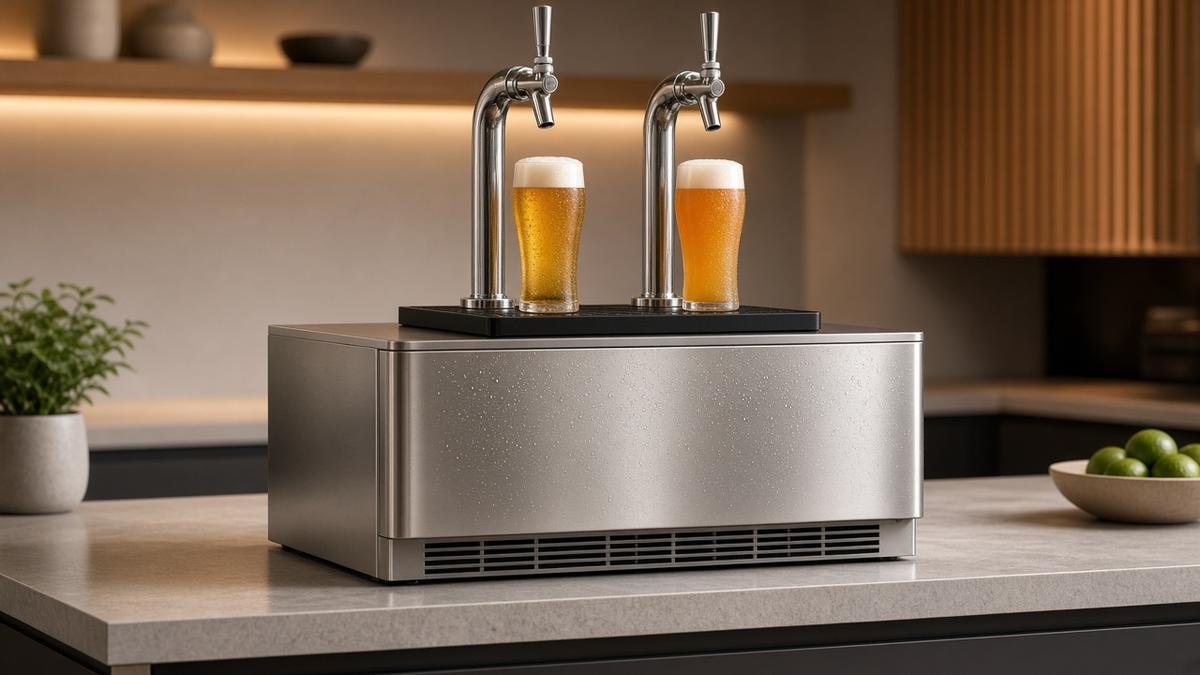
- Best plug-and-play: KOMOS V2 kegerator (or similar homebrew-ready kegerator) — built for ball-lock corny kegs, stainless taps, looks good in a kitchen. ~$900–$1,300 depending on tap count. → Check price at MoreBeer
- Best budget: Mini-fridge conversion kit — use a fridge you already own (or a used one) plus a conversion kit. ~$250–$400 complete. → Kits at Northern Brewer
- Best for small spaces / no fridge: Pressurized growler or mini-keg system (e.g., uKeg-style, 128 oz) — not a true keg setup, but great for one or two growlers of fresh beer. ~$100–$200 each. → Amazon
- Best “do-everything” kegerator: commercial-style 1/2-barrel kegerator converted to corny kegs — fits 2–3 cornies, good used value. ~$450–$800 plus conversion parts.
Comparison Table
| Setup | Best for | Kegs (5 gal corny) | Taps | Effort to build | Typical complete price* | Buy |
|---|---|---|---|---|---|---|
| Chest-freezer keezer | Most brewers, 3+ beers on tap | 4–6 | 3–6 | Moderate (collar build) | $550–$900 | Freezer + parts |
| Homebrew kegerator (KOMOS-style) | Plug-and-play, kitchen-friendly | 2–3 | 2–3 | Low | $900–$1,300 | MoreBeer |
| Commercial kegerator + corny conversion | Good used deals | 2–3 | 1–3 | Low–moderate | $600–$1,000 | Amazon |
| Mini-fridge + conversion kit | Budget, 1–2 beers | 1–2 | 1–2 | Moderate (drill tower/door) | $250–$400 (fridge extra) | Northern Brewer |
| Picnic tap only (no tower) | Cheapest start | 1–2 | picnic taps | Very low | $200–$300 (fridge extra) | MoreBeer |
| Pressurized growler | Small batches, portability | n/a | 1 | None | $100–$200 | Amazon |
*Complete price = cold box + at least one keg + CO2 tank + regulator + lines + faucet/shank or picnic tap. CO2 fill extra.
What “Complete Price” Really Means
This is where most kegerator listings mislead beginners. A $650 “kegerator” often ships without a CO2 tank, a corny keg, or a ball-lock coupler. Here’s the parts list every setup needs:
| Component | Typical price | Notes |
|---|---|---|
| Cold box (fridge, freezer, kegerator) | $0–$1,000+ | Used fridges/freezers are the biggest savings |
| Corny keg (5 gal, ball lock), new | $90–$140 each | Used kegs ~$50–$80 but need new O-rings |
| CO2 tank, 5 lb aluminum | $60–$100 | Often bought empty; first fill or swap extra |
| Dual-gauge primary regulator | $50–$100 | Secondary regulators let different beers run at different pressures |
| Gas manifold (2–4 way) | $25–$60 | Needed for more than one keg at one pressure |
| Beer + gas lines, disconnects | $20–$50 per tap | Use EVABarrier / duotight style lines for less off-flavor and easy cleaning |
| Faucet + shank (or tower) | $40–$100 per tap | Forward-sealing stainless (Intertap, Perlick) resists sticking |
| Temperature controller (keezers) | $35–$60 | Inkbird-style; overrides the freezer’s thermostat |
| CO2 fill/swap | $20–$35 | Local welding or homebrew shop |
Example: a 1-tap entry setup in a fridge you already own: keg ($110) + 5 lb tank ($80) + regulator ($70) + lines/disconnects ($35) + picnic tap ($10) ≈ $300 before CO2 fill.
Example: a 4-tap keezer: 7 cu ft chest freezer (~$250–$300) + temp controller ($45) + wood collar ($40–$80 lumber) + 4 kegs ($440) + tank/regulator ($150) + 4-way manifold ($45) + 4 faucets/shanks ($240) + lines ($80) ≈ $1,300–$1,400 with four kegs — or about $900 if you start with two kegs.
The keezer looks expensive until you divide by taps. Per tap, it’s usually the cheapest serious option.
Free: The Complete-Price Brewing Gear Checklist
Before you buy a brewing system, make sure you are not missing the pump, chiller, controller, or electrical upgrade that doubles the real cost. Get our one-page checklist of everything you need to brew your first batch, with no surprises at checkout.
Email addressSend me the checklist
One useful email when guides are updated. No spam. Unsubscribe anytime. (Sign-up form coming soon.)
The Setups, Compared
- Chest-Freezer Keezer — Best Overall
Who it’s for: Brewers who want 3+ beers on tap and don’t mind an afternoon with a drill.
A keezer is a chest freezer with a temperature controller (so it holds 36–40°F instead of freezing) and usually a wooden collar between the lid and body to mount faucets without drilling into coolant lines.
Likes
– Lowest cost per tap
– Holds a CO2 tank inside with room for 4–6 kegs (size dependent)
– Very efficient; chest freezers hold cold well
– Reusable: unplug the collar idea and it becomes a fermentation chamber
Dislikes
– Lifting full 50 lb kegs over the lip gets old
– Needs a build (collar, drilling, sealing)
– Moisture/condensation — a small DampRid or fan helps
Sizing: A 7 cu ft freezer typically fits 4 corny kegs plus a 5 lb tank on the hump; check interior dimensions against keg diameter (~8.5 in) and height (~25 in) before buying.
Shop keezer parts at MoreBeer · Inkbird temp controller on Amazon
- Homebrew-Ready Kegerator (KOMOS-style) — Best Plug-and-Play
Who it’s for: People who want it to look good and work out of the box.
Kegerators built for homebrewers ship with ball-lock disconnects, stainless forward-sealing faucets, and room for 2–3 corny kegs. KOMOS (sold by MoreBeer) is the best-known; other brands exist. Check what’s included — some bundles include a CO2 tank and kegs, many don’t.
Likes
– Front-loading, no lifting over a lip
– Finished furniture look for kitchens and living rooms
– Usually includes faucets, lines, and regulator
Dislikes
– Highest upfront price
– Limited to 2–3 kegs
– Compressor fridges cost more to run than chest freezers
Check KOMOS price at MoreBeer
- Commercial Kegerator Converted to Corny Kegs — Best Used Value
Who it’s for: Bargain hunters; these show up used on Marketplace and Craigslist constantly.
Standard kegerators (EdgeStar, Kegco, Danby-style) are built for one commercial 1/2-barrel keg with a D-coupler. Remove the shelf/coupler, add ball-lock disconnects, and most fit 2 corny kegs (sometimes 3, sometimes with the tank outside).
Likes: Cheap used; tower and faucets already included. Dislikes: Interior fit varies by model; stock faucets are often rear-sealing chrome that sticks.
Kegerators on Amazon · Ball-lock conversion parts at Northern Brewer
- Mini-Fridge + Conversion Kit — Best Budget
Who it’s for: First kegging setup, one or two beers.
Most dorm fridges are too small; you want an interior tall enough for a corny (~25 in plus disconnects). Kits from Northern Brewer and MoreBeer bundle keg, tank, regulator, lines, and picnic tap or door faucet.
Likes: Lowest entry cost; easy upgrade path. Dislikes: Fridge fit is the gotcha; door-mount faucets require drilling.
Kegging kits at Northern Brewer · MoreBeer kits
- Pressurized Growlers — Best Without a Fridge
Who it’s for: Small-batch brewers or anyone who wants to take beer to a party.
Not a full kegging system, but a CO2-cap growler holds 64–128 oz under pressure in your regular fridge. Great complement to a keg setup.
Check pressurized growlers on Amazon
Buyer’s Guide
Ball Lock vs Pin Lock
Homebrew kegs (“cornies”) came from the soda industry in two styles:
- Ball lock — originally Pepsi. By far the most common today; new kegs are almost all ball lock. Parts are everywhere. Buy ball lock unless you already own pin lock.
- Pin lock — originally Coke. Slightly shorter and wider; used ones are sometimes cheaper. Disconnects are not interchangeable with ball lock.
Don’t mix styles unless you want two sets of disconnects. Also check gas vs liquid post orientation — post threads and poppets vary slightly by manufacturer.
CO2 Tank Size
- 5 lb: Fits inside most keezers/kegerators; carbonates and serves roughly 6–8 five-gallon kegs depending on leaks and force-carbing.
- 10 lb / 20 lb: Fewer refills, cheaper per pound, but usually lives outside the fridge with the gas line through a wall or collar.
Many shops swap tanks instead of refilling. If yours swaps, don’t overpay for a shiny new tank — you’ll hand it back.
Regulators
A dual-gauge primary regulator shows tank pressure and serving pressure. If you want to serve a highly carbonated wheat beer next to a low-carb stout, add a secondary regulator body. Buy a decent brand (Taprite, Micro Matic) — cheap regulators creep, which over-carbonates beer.
Faucets
Forward-sealing stainless faucets (Intertap, Perlick, Nukatap) don’t stick between pours and are worth the upgrade over rear-sealing chrome. Intertap’s modular system lets you add a growler filler or flow control later.
Line Length and Foam
Foamy pours are the #1 kegging complaint, and it’s almost always line balance. With standard 3/16″ vinyl, many brewers start with 8–10 feet of beer line at 10–12 PSI and 38°F. Flow-control faucets let you get away with shorter lines.
Carbonating
- Set and forget: 10–12 PSI at ~38°F for 1–2 weeks. Lowest risk of overcarbonation.
- Burst carb: 30–40 PSI for 24–36 hours, then drop to serving pressure. Faster, needs attention.
- Shaking: Fast but easy to overshoot. Not recommended for beginners.
Cleaning
Clean lines every keg change or every few weeks with a line cleaner (BLC or similar) and a cleaning keg or pump. EVABarrier-style lines resist staining and flavor carryover.
Pressure Fermenting and Kegging Together
If you ferment under pressure (in a corny or an all-rounder fermenter), a spunding valve lets you naturally carbonate during fermentation and do closed transfers into serving kegs — less oxygen, fresher hoppy beer. Pair this with good fermentation temperature control.
Verdict
- If you want the most taps for the money and have garage/basement space, build a keezer.
- If you want it in the kitchen and working today, buy a homebrew-ready kegerator like KOMOS.
- If you’re on a tight budget or testing kegging, start with a conversion kit and a used fridge, picnic tap first.
- If you mostly share beer away from home, add pressurized growlers.
Whatever you choose, budget for at least two kegs (one serving, one conditioning) and a quality regulator.
Shop kegging at MoreBeer · Northern Brewer kegging kits · Amazon
What Else You’ll Need
- A brew system that fills a keg every time → Best All-in-One Electric Brewing Systems
- Clean, controlled fermentation before the beer ever hits the keg → Best Fermentation Temperature Control
- Know when fermentation is truly done before you keg → Best Digital Hydrometers
FAQ
Is kegging worth it for homebrewers?
For most people brewing more than a few times a year, yes. It saves hours per batch, and carbonation is faster and adjustable. The upfront cost (~$300 minimum) is the main downside.
How much does a basic homebrew kegging setup cost?
Roughly $250–$400 for one keg, a tank, regulator, lines, and a picnic tap if you already have a fridge. A full keezer runs $900–$1,400.
Ball lock or pin lock?
Ball lock. It’s the current standard with the widest parts availability.
Can I use a commercial kegerator for homebrew?
Yes — swap the D-coupler for ball-lock disconnects. Most fit two corny kegs; check interior dimensions.
How long does a 5 lb CO2 tank last?
Typically several kegs — often 6–8 five-gallon batches — but a single leak can empty it overnight. Spray connections with Star San to check.
What temperature should a kegerator be?
Most brewers serve at 36–40°F. Warmer beer needs more pressure to stay carbonated.
Why is my keg pouring foam?
Usually line too short, pressure too high, or beer too warm. Add line length or a flow-control faucet.
Can I keep a CO2 tank inside the kegerator?
Yes, and it’s common. Some people prefer outside so leaks are easier to spot and tank pressure readings stay consistent.
Keezer vs kegerator — which is better?
Keezer for capacity and cost per tap; kegerator for convenience and looks.
Do I need a temperature controller for a keezer?
Yes. Without one, a chest freezer will freeze your beer.
About the author
Written by Mike — 20 years of brewing, from extract syrup and a Cajun cooker to a 10-gallon electric brewery rig. He started Homebrew Rigs to give brewers honest, complete-price gear comparisons with no paid rankings. Pages are updated at least yearly. Read how we research gear on our Methodology page.